
The Real Reason PPF Turns Yellow
Ask any paint protection film (PPF) installer what complaint comes back most often from customers, and the answer is almost always the same: the film turned yellow. A car wrapped in what was advertised as premium TPU starts to show a warm amber tint after a year or two, and the customer wants to know why.
From a materials-engineering standpoint, the answer is clear and does not come down to coating quality, additive packages, or application skill. It comes down to one foundational choice made long before the film is ever extruded: is the TPU base aromatic or aliphatic?
Aromatic vs. Aliphatic TPU: A Structural Difference
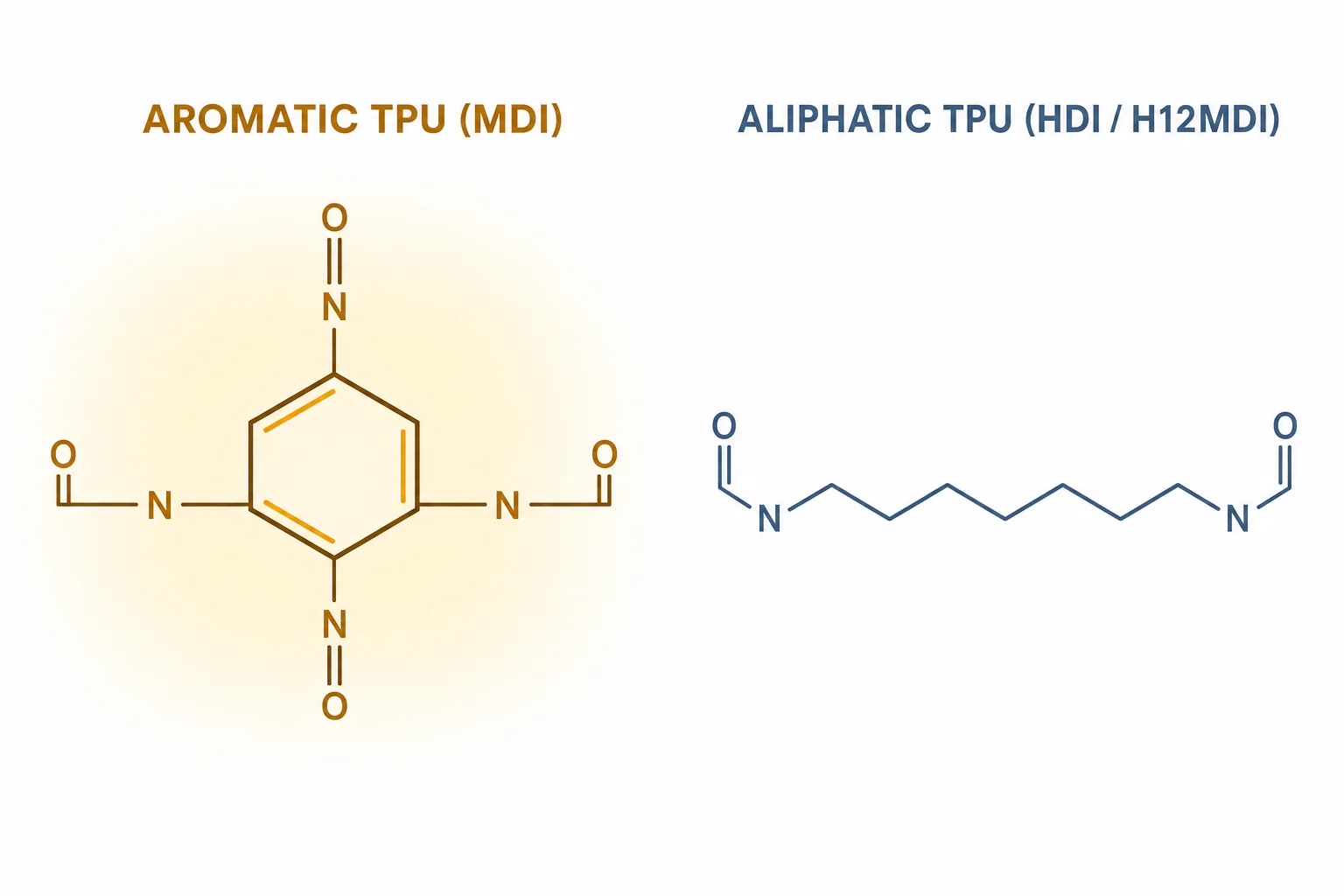
Paint-protection-grade TPU is built around a diisocyanate core, and there are only two families that matter. The anti-yellowing gap between them is structural — it cannot be closed by formulation, process tuning, or more expensive additives.
Aromatic TPU (MDI)
Aromatic TPU is made with MDI (methylene diphenyl diisocyanate). Its molecular chain carries benzene rings with a conjugated structure. Under prolonged outdoor UV and high-temperature oxidation, those benzene rings gradually photo-oxidize and continuously generate quinoid chromophores — compounds that absorb visible light strongly.
The visible result is a slow, one-way progression: clear → pale yellow → deep yellow → brown. This is the chemical fate of aromatic TPU. No amount of UV absorber or hindered amine light stabilizer (HALS) can stop it — those additives only delay the oxidation of the benzene ring and stretch out the yellowing timeline. They cannot remove the root cause.
Aliphatic TPU (HDI / H12MDI)
Aliphatic TPU is made with HDI (hexamethylene diisocyanate) or H12MDI (hydrogenated MDI). Its backbone is a saturated aliphatic chain: no benzene ring, no conjugated chromophore system. This eliminates the possibility of photo-oxidation forming quinoid color bodies in the first place.
Under long-term outdoor exposure and repeated hot-cold cycles, aliphatic TPU shows essentially no color shift. It is currently the only base material capable of true long-term, permanent anti-yellowing performance in paint protection film.
Why "Just Add More UV Stabilizers" Does Not Work
The most common material-selection mistake we see is the belief that loading aromatic TPU with extra UV absorbers will deliver permanent anti-yellowing. It will not. UV absorbers and light stabilizers work by competitively absorbing UV energy and scavenging free radicals — they slow aging, but they do not change the aromatic TPU's benzene-ring core.
Under continuous outdoor sunlight, these additives are consumed irreversibly. Once they are depleted, the oxidation that was being held back releases all at once, and yellowing accelerates beyond the earlier rate. Additives buy time, not a lifetime warranty.
The Cost Myth Is Fading
For years, the reason some manufacturers stayed with aromatic TPU was raw-material price — aliphatic once cost two to three times as much. That has changed substantially in the 2025–2026 market: with the breakthrough in domestic TPU mass production, the price gap has narrowed to roughly 40–80%.
What still keeps some lines on aromatic is not material cost but manufacturing difficulty: aliphatic polymerization is more demanding, extrusion yields are lower, and volume-production control has a higher threshold. The bottleneck is on the processor side, not the material side.
YUNNIAN: 100% Aliphatic TPU Across the Product Line
YUNNIAN New Material Technology builds every PPF product on aliphatic TPU. From our N-series polycaprolactone films to the K-series (Covestro), M-series (Mitsui), and our specialty black and matte finishes, the base material is aliphatic — no aromatic TPU, no benzene-ring yellowing risk.
Choosing an aliphatic base is the single most important anti-yellowing decision in PPF, and it is one we made across the board so our wholesale and OEM partners never have to defend a yellowing warranty claim.
How to Choose the Right TPU for Your Line
A practical note for film converters: not every product has to be aliphatic. The right choice follows product positioning and application.
- Strength-critical, low-color-priority uses (for example, outdoor inflatable boats) can stay with aromatic TPU.
- Color-critical and long-warranty applications — paint protection film, high-end wraps, anything with an anti-yellowing promise — should be aliphatic.
Think of anti-yellowing as three coordinated layers: the base material decides whether the film can avoid yellowing at all; the additive package decides when yellowing starts; and the functional topcoat decides whether yellowing is exposed early. The base sets the ceiling — get that wrong, and the other two layers can only buy time.
Transparency Is the Real Fix
The paint protection film industry's biggest problem is not that the technology falls short — it is that information is not transparent. Selling an aromatic-TPU product with an aliphatic-TPU promise eventually burns the whole industry's reputation when yellowing appears. YUNNIAN's position is simple: name the base material, match the promise to the chemistry, and let the customer buy with confidence.
0 comments